Who was Molech or Moloch?
Molech was a false god of ancient Canaan.
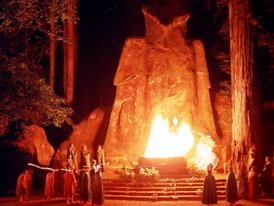 |
Moloch worshipers
at a pagan shrine.
Cultic Worship Sites Discovered
in Eilat Mountains of Southern Israel
“The LORD said also unto me in the days of Josiah the king, Hast thou seen that which backsliding Israel hath done? she is gone up upon every high mountain and under every green tree, and there hath played the harlot.” KJV, Jeremiah 3:6
“When Josiah was king of Judah, the LORD said to me, “Jeremiah, you have no doubt seen what wayward Israel has done. You have seen how she went up to every high hill and under every green tree to give herself like a prostitute to other gods.” NET Bible, Jeremiah 3:6
A Survey of Neolithic Cult Sites in
The Eilat Mountains of Israel + Photos
Molech was the ancient
Ammonite fire god.
As early as 1450 BC, as they wandered in the wilderness, Israel was worshiping Moloch, even before they entered the land of Canaan. For that reason, God and Moses prohibited Israel from worshiping Moloch in Leviticus 18:21 and 20:2, 3, 4, 5.
“Have ye offered unto me sacrifices and offerings in the wilderness forty years, O house of Israel? But ye have borne the tabernacle of your Moloch and Chiun your images, the star of your god, which ye made to yourselves.” – Amos 5:25-26 and Acts 7:42-43
In their forty years of wilderness wandering and backsliding, wicked stony-hearted rebellious Israel chose the wrong god and the wrong tabernacle. They preferred to worship goat idols and demons instead of the one true God. God’s warning against worshiping Molech the Canaanite fire god, is given in a religious context. Believing Jews and non-Jews living in the land of Israel were also prohibited from pagan sexual worship of the Canaanite fertility goddess because God viewed such pagan worship as abomination.
God intended to prevent His people from practicing the shrine prostitution of the Canaanites, which He warned against in Leviticus 18:3 and 20:23. The word translated Mo-lech or Moloch (the spelling varies), occurs multiple times in the Bible, in Leviticus 18:21, 20:2, 3, 4, 5, 1 Kings 11:7, 2 Kings 23:10, Jeremiah 32:35, Amos 5:25-26, Acts 7:42-43.
God placed the Holiness Code prohibitions of Leviticus 18:22 and 20:13 in the context of worshiping false gods, 18:3, 21-22 and 20:2-5, 13, 23. For many centuries before Israel entered the land of Palestine, ancient Canaanite fertility cults used same sex rituals to worship their false gods.
God prohibited Israel from adopting the cultic sexual fertility goddess worship of Egypt and Canaan, Lev 18:3, 20:23. The issue with God was not committed faithful non-cultic sexual relationships or gay marriages between two men or two women. The issue with God was shrine prostitution and pagan worship of false gods.
Scripture deals with shrine prostitution
under the rubric of worshiping
the false gods of Canaan.
The NET Bible, not considered gay friendly by anyone, takes a strong anti-gay position on Leviticus. This reflects the strong anti-gay beliefs of Dallas Theological Seminary (which trained some of the folks associated with the NET Bible).
Yet in spite of being so anti-gay, the NET Bible links the Mo-lech worship of Leviticus 18:21 and 20:2-5, 13, with sexual sin and with spiritual prostitution, “I will cut off from the midst of their people both him and all who follow after him in spiritual prostitution, to commit prostitution by worshiping Molech (Hebrew – to commit harlotry after Molech).” Leviticus 20:5.
The adjective “spiritual” was inserted by the translators because in their opinion this is not a reference to literal prostitution but figuratively compares idolatry to prostitution. Regardless their opinion, notice that even anti-gay Christians admit Leviticus 18:22, “Thou shalt not lie with mankind, as with womankind: it is abomination.” and 20:13, are in the context of harlotry or prostitution and Molech worship.
The NET Bible on Leviticus 18:21, Note 30, says: “…It could refer to either human sacrifice or a devotion of children to some sort of service of Molech, perhaps of a sexual sort (cf. Lev 20:2-5; 2 Kgs 23:10, etc.). The inclusion of this prohibition against Molech worship here may be due to some sexual connection of this kind, or perhaps simply to the lexical link between זֶרַע (zera’) meaning “seed, semen” in v. 20 but “offspring” in v. 21.”
Who Was Moloch?
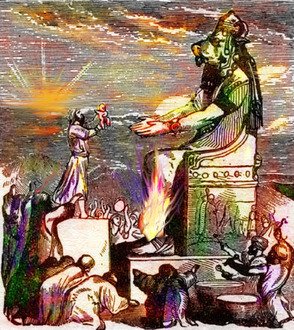 |
Moloch, national
Ammonite deity,
a fire god worshiped throughout the ancient near East and North Africa, by Canaanites and Philistines, Arameans and Semitic peoples and later, Phoenicians. He was known by many names, all signifying the same false god.
Names of Molech or Moloch
Anyone who reads history knows that various writers in various countries spell names differently. These names all refer to the same false god.
Melech, Mo-lech, Milcom, Melkom, Moloch, Molek, Malec, Malik, Melek, Malkum, Melqart, Melkart, Milk, Melqarth, Kronos, Cronus. In Islam, Mo-lech is called Malec or Malik (meaning King), believed to be the principle angel in charge of Djahannam, the Islamic version of hell.
That Molech worship was already common among the Canaanites when Israel entered the land is evident from the fact that, before Israel entered the land, God warned them against Molech worship as an abomination the Israelites were forbidden to practice, Leviticus 18:21, 20:2, 3, 4, 5. Fire gods like Moloch and his fertility goddess consort, Ashtoreth, were not religious fantasies. They exercised a very real power over the primitive Canaanites. And their pagan worship snared some of the children of Israel.
Who Was Ashtoreth?
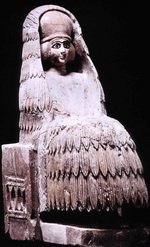 |
Ashtoreth was the fertility goddess consort of Molech.
Ashtoreth is mentioned three times in scripture, in 1 Kings 11:5 & 33, 2 Kings 23:13. When Ashtoreth is mentioned in scripture, she is linked to Molech, (also called Milcom in the Bible).
Ashtaroth is mentioned 12 times in the Old Testament. The word is used as the name of a town in ancient Israel in Deuteronomy 1:4, Joshua 9:10, 12:4, 13:12, 13:31 and 1 Chronicles 6:71. That towns were named after the fertility goddess indicates that her worship was already widespread when the children of Israel entered the land of Canaan.
In Judges 2:13 & 10:6, 1 Samuel 7:3 & 4, 12:10 & 31:10, Ashtaroth refers to the ancient Canaanite fertility goddess, with a slightly different spelling than Ashtoreth. Ashtoreth was the goddess of war and fertility, called Ishtar by Assyrians and Babylonians, called Astarte by Greeks and Romans and called Tanith by North Africans.
Molech represented the male principle of life and reproduction while Ashtoreth represented the female principle of fertility.
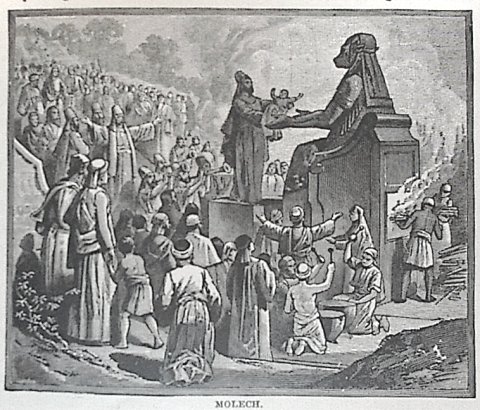
Molech, fire-god of ancient Canaan
The sexual relationship between
these false gods set an example
for unbridled sensuality
among their worshipers.
Anal sex between male and male worshipers and male and female worshipers was viewed as an offering to the goddess. Some 1450 years after Leviticus, the Apostle Paul references pagan worship in Romans 1:26-27, when he blasts the same kind of fertility goddess worship in first century Rome.
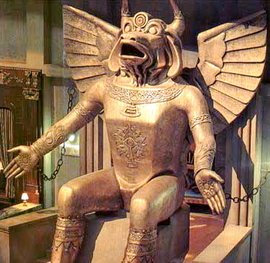 |
Artist’s depiction of
a Molech idol
The Molech idol was a large hollow brass statue with the head of a bull and the bulging belly of a man. It was designed like an old fashioned pot-bellied stove, with the belly as the firebox. A child sacrifice laid on the hands, would roll into the fire in the belly cavity. Scripture describes this practice as “passing through the fire to Molech,” Leviticus 18:21.
Cleitarchus On Molech
Cleitarchus, an ancient historian, around 315 BC, gives this description of a fire god at Carthage. Kronos is the north African name for Molech.
“There stands in their midst a bronze statue of Kronos, its hands extended over a bronze brazier, the flames of which engulf the child. When the flames fall upon the body, the limbs contract and the open mouth seems almost to be laughing until the contracted body slips quietly into the brazier.”
Diodorus Siculus On Molech
Diodorus Siculus, 90-30 BC, gives this description of a Carthaginian fire god.
“There was in their city a bronze image of Cronus extending its hands, palms up and sloping toward the ground, so that each of the children when placed thereon rolled down and fell into a sort of gaping pit filled with fire.”
Plutarch On Molech
Plutarch, AD 46-127, senior priest of the oracle at Delphi, gives this description of the fire god.
“The whole area before the statue was filled with a loud noise of flutes and drums so that the cries of wailing [of the children being sacrificed] should not reach the ears of the people.”
One can readily see why God and Moses called this pagan religious practice and the sexual rites associated with it, abomination. Moloch worship is essentially identical with worship of Chemosh of Moab, Cronus-Kronos of Carthage and Melkart-Melqart of Tyre. The general name, used throughout Palestine and in the Bible, for this type of fire god, was Baal. According to the Jewish Encyclopedia, the Hebrews first learned Baal worship from the agricultural Canaanites.
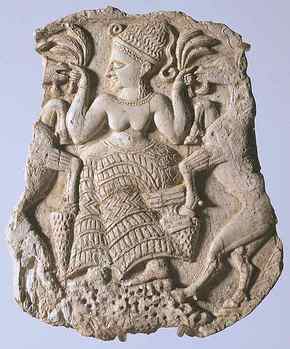 |
Ancient fertility goddess
The religious Canaanites worshiped a fertility goddess named Ashtoreth.
In Ashtoreth’s worship services, male worshipers had anal sex with priests and priestesses of the goddess. This was viewed as an offering to the fertility goddess. The priests and male prostitutes, who were consecrated to her cult were called qadesh, qedishim or sodomites, Deuteronomy 23:18; 1 Kings 14:24; 15:12; 22:46.
Male qedishim engaged
in shrine prostitution,
allowing male worshipers to use them for anal sex, as did the sacred harlots, 2 Kings 23:7. The Interpreter’s Dictionary of the Bible tells us that pagan religions of the ancient near east shared a common feature. They were fertility cults who worshiped a Mother goddess.
“Fertility rites were practiced at the numerous shrines which dotted the land, as well as at the major sanctuaries… A characteristic feature of the fertility cult was sacral sexual intercourse by priests and priestesses and other specially consecrated persons, sacred prostitutes of both sexes… Child-sacrifice was also a feature of the rites…”
The Interpreter’s Dictionary of The Bible, Volume 3, Abingdon, 1990, pages 933-934.
The International Standard Bible Encyclopedia tells us Ashtoreth was a
“goddess of Canaan and Phoenicia… prostitution was practiced in her name and she was served with immoral rites by bands of men and women.” International Standard Bible Encyclopedia, Volume 1, 1979, pages 319-320.
Asherah figure,
the Canaanite
fertility goddess
Given this cultural, historical and religious context, it becomes clear that God did not intend to forbid a loving, committed gay relationship or gay marriage between two men or two women. Instead, God intended to forbid Israel, His people, from practicing the same sex religious rites with which the ancient Canaanites worshiped their fertility goddess.
There is no connection between
modern homosexuality and
ancient fertility goddess worship.
Leviticus 18:22 and 20:13 simply do not address modern gay and lesbian relationships.
Helpful Links To
Additional Information
sodomites are NOT gays or lesbians
How should modern Christians interpret
Leviticus 18:22 and 20:13?
Idolatry always included
sex worship of false gods.
Why is Cybele vital to
understanding Romans 1?
Pagan Practices of ancient Canaanites
Shrine Prostitutes used sex
to worship pagan gods
From Molech, Return To
Gay Christian 101 Home Page
Google Translate
into 90 languages

We are saved:
by grace alone through faith alone
Recent Articles


-
Gay Christian 101 – Affirming God’s glorious good news for all LGBs.
Jan 08, 24 12:57 AM
 Gay Lesbian Bisexual Christian 101 – Accurate biblical and historical info defending LGB Christians from the anti-gay crowd.
 -
Romans 1 describes ancient shrine prostitution, not gays and lesbians.
Dec 21, 23 04:37 PM
 Romans 1, in historical context, is about ancient Roman fertility goddess worshipers who engaged in shrine prostitution to worship Cybele, not gays and lesbians.
 -
The Centurion And Pais – When Jesus Blessed A Gay Couple.
Nov 14, 23 10:32 PM
 Centurion and Pais? If Jesus blessed a gay relationship, would this change your view of homosexuality?
Bible Study Resources
for eDisciples