Did you know the Law of Moses
only applied to Jews and
resident aliens living in Israel?
 |
Law of Moses – Many Christians believe that since the Bible says “a man shall not lie with a man,” that declares God’s universal prohibition of homosexuality.
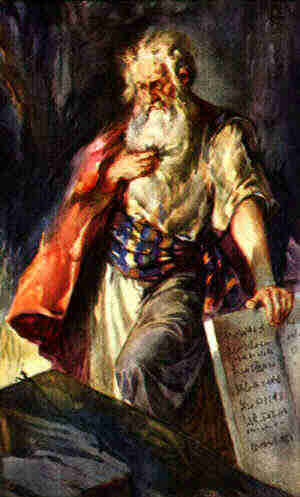
Moses the Jewish Lawgiver, human author of the Torah gave law of Moses to the Jews.
The problem is, that view does not fit what the Bible says in context. Context is important. If we take verses out of context, the Bible can be made to teach almost anything. The prohibitions in the Holiness Code were not universal prohibitions. For example, God did not require Egyptians to keep the Holiness Code. The prohibitions of the Holiness Code were not enforced on any other nation except Israel before, during or after the Holiness Code was given.
How did ancient Jews understand Leviticus 18 and 20? Did ancient Jews believe everyone in the Old Testament, beginning with Adam and Eve, was required to live under the Holiness Code? The very chapters so frequently used against gays and lesbians, Leviticus 18 and 20, prove that ancient Jews understood that the Law did not apply universally. Ancient Jews understood that the Law did not apply to anyone until God gave it to Moses around 1450 B.C.
Three Thoughtful Propositions
about law of Moses
- If the Law of Moses did not apply before it was given, then it naturally follows that the Law does not apply after it ends.
- If the Law does not apply after it ends, then the Law of Moses is not in force right now.
- If the Law is not in force right now, then no Christian has to live under the requirements of the Holiness Code to get saved, to stay saved or to be right with God.
Here are four clear examples from the Holiness Code which support this rock solid Bible truth.
Example 1. Leviticus 18:9 forbids sexual relations with your sister.
“The nakedness of thy sister, the daughter of thy father, or the daughter of thy mother, whether she be born at home, or born abroad, even their nakedness thou shalt not uncover.” Leviticus 18:9.
“Uncover the nakedness” is a euphemism for “have sex with.” Hundreds of years before the Law was given, Abraham married his sister Sarah and enjoyed a lifelong “abominable” forbidden sexual relationship with her.
“And Abraham said of Sarah his wife, She is my sister.” Genesis 20:2.
“And yet indeed she is my sister; she is the daughter of my father, but not the daughter of my mother; and she became my wife.” Genesis 20:12.
 |
It is clear that Levitical Law did not apply to Abraham and Sarah. God richly blessed this “abominable” brother-sister marriage and made an Eternal Covenant with Abraham while Abraham and Sarah were in their “abominable” marriage.
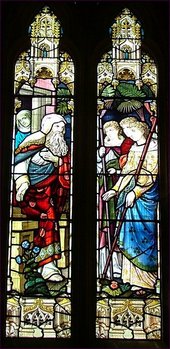
Abraham and Sarah Stained Glass window, St. Michael and All Angels Church, Bootan.
In spite of the brother-sister marriage prohibition in the Law, scripture indicates that brother-sister marriage was still being practiced in Israel during the time period when Israel was under the Law. For example, when King David’s son, Prince Amnon attempts to rape Princess Tamar, his half-sister, Tamar says:
“Now therefore, I pray thee, speak unto the king [David]; for he will not withhold me from thee.” 2 Samuel 13:13.
Princess Tamar must have had good reason to believe what she told her half-brother, in spite of what the Law of Moses said. Centuries after Prince Amnon raped Princess Tamar, Ezekiel the prophet says of Jerusalem’s inhabitants:
“another hath lewdly defiled his daughter in law; and another in thee hath humbled his sister, his father’s daughter.” Ezekiel 22:11.
Ezekiel was written between 622-600 BC. The Law had been in force for 800 years at this time. Yet even during the Babylonian captivity, Israel continued to violate the Law of Moses. Perhaps the children of Israel were so wicked they did not care what the Holiness Code said or perhaps they believed the Holiness Code did not apply to them while they were living outside the land of Israel. Either option is possible.
The point is that ancient Jews knew the Law did NOT apply universally. Ancient Jews understood that the Holiness Code did not apply to Abraham and Sarah. Scripture is unmistakably clear about that.
The Law of Moses was
not always in force.
It had a starting point.
“The LORD made not this covenant with our fathers, but with us, even us, who are all of us here alive this day.” Deuteronomy 5:3.
Since God gave the law to Moses, surely we can trust Moses when he tells us, under inspiration, that the Law did not apply to the fathers, Adam, Seth, Enoch, Abraham, Isaac and Jacob.
 |
The Holiness Code did not apply to anyone anywhere until it was given on Mt. Sinai. The Law had a distinct starting point and a distinct ending point.
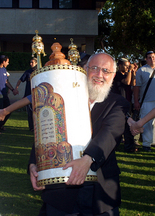
Carrying a Torah Scroll which contains the five books of Moses.
The Law applied to Jews and resident aliens, in the land of Israel, a particular people in a particular land in a particular cultural situation under a particular law at a particular time in history. The Holiness Code did not apply to anyone before the time period when God gave the Law to Moses. And according to the New Testament, the Law went out of force when Jesus died on the Cross.
Example 2. Leviticus 18:12 forbids sexual relations with your aunt.
“Thou shalt not uncover the nakedness of thy father’s sister [your aunt]: she is thy father’s near kinswoman.” Leviticus 18:12.
“Uncover the nakedness” is a euphemism for “have sex with.” In Exodus we learn that Moses’ own father, Amram, married his aunt, his father’s sister, Jochebed.
“And Amram took him Jochebed his father’s sister to wife; and she bare him Aaron and Moses.” Exodus 6:20.
The parents of Moses were in an abominable, forbidden, nephew-aunt marriage. What God considered an abomination under the Law of Moses, clearly, was not an abomination before the Law of Moses. It cannot be argued that Moses was unaware that his parent’s marriage violated God’s Law. Moses wrote the book of Leviticus and he also wrote Exodus 6:20. He knew exactly what kind of marriage his parents had. He knew their marriage was an abomination under the Law yet scripture never condemns Amram and Jochebed for their incestuous, abominable relationship.
What we see in scripture is that God richly blessed their “abominable” relationship with three incredible children, Miriam, Aaron and Moses, whom God used to lead the nation of Israel. Amram, Moses’ father, lived to the ripe old age of 137.
And “the years of the life of Amram were an hundred and thirty and seven years.” Exodus 6:20.
Scripture does not tell us when Jochebed died but it is possible she was still living when the Law of Moses was given. Here then, we have Moses’ own parents, living in a relationship clearly condemned as abomination under the Law of Moses. Yet God blessed their “abominable” forbidden relationship and God blessed Miriam, Aaron and Moses, the offspring of their “abominable” forbidden relationship.
Relationships such as Amram and Jochebed’s may have been grandfathered into the law of Moses, and were therefore allowed, even while the Law was in force. The Law did not apply to them because the Law had not been given when Amram married Jochebed. Remember what Moses and scripture said concerning when the Law would go into effect.
The Law of Moses was
not always in force.
It had a starting point.
“The LORD made not this covenant with our fathers, but with us, even us, who are all of us here alive this day.” Deuteronomy 5:3.
Scripture is clear. Before God gave Moses the Law, relationships which the Law describes as abomination, were not an abomination and were not forbidden. In fact, they were perfectly fine for God’s people and had God’s blessing.
Example 3. Leviticus 18:15 forbids sexual relations with your daughter in law.
“Thou shalt not uncover the nakedness of thy daughter in law: she is thy son’s wife; thou shalt not uncover her nakedness.” Leviticus 18:15.
“Uncover the nakedness” is a euphemism for “have sex with.” In Genesis 38:12-30, hundreds of years before the Law was given, Judah, one of the sons of Jacob, had an abominable, forbidden sexual relationship with his daughter in law Tamar and she became pregnant. Judah and Tamar were not under the Law of Moses because the Law had not been given at the time they lived.
Their sexual encounter was apparently a spur of the moment thing for Judah but not for Tamar. It appears to be a planned event for her. She apparently knew her father in law well enough to believe he would have sex with a shrine prostitute if one was available.
Tamar disguised herself in the veil and clothing of a shrine prostitute and waited along a road she knew Judah would travel when he went to check on his sheep. Just as Tamar expected, when Judah saw her along the road, thinking she was a shrine prostitute, he stopped to have sex with her.
During their encounter, Judah never saw her face. He did not recognize who she was. He did not know at the time that he was having sex with his daughter in law. In spite of the fact that this abominable relationship was forbidden under the Law of Moses, God forgave their sin and placed Judah, his daughter in law Tamar and their illegitimate offspring, Phares and Zarah, into the genealogy of Christ, Matthew 1:3.
This story points out the fact that the Law of Moses was not the standard by which God judged people during Judah and Tamar’s lifetime. In the same way, the Law of Moses is not the standard by which God expects us to live today. What God considered abomination under the Law was frequently not considered abomination before the Law was given.
Strange as it may seem to us in the twenty first century, God actually blessed the relationship which the Holiness Code calls abominable, by placing Judah, Tamar, Phares and Zarah in the lineage of Christ, Matthew 1:3.
Example 4. Leviticus 18:18 forbids marrying two sisters.
“Neither shalt thou take a wife to her sister, to vex her, to uncover her nakedness, beside the other in her life time.” Leviticus 18:18.
“Uncover her nakedness” is a euphemism for “have sex with.” In Genesis 29:18-28, Jacob married Leah and Rachael, two sisters. Did Jacob commit an abomination by marrying two sisters? The answer is No, of course not, because the Law had not yet been given, therefore the Law was not the standard by which God judged the world in Jacob’s lifetime.
In the same way, the Law is no longer in effect today, Romans 6:14, 10:4, Galatians 3:24-25, therefore God never requires us to live under the Law of Moses today.
Jehovah gave the children of Israel eternal promises through Jacob the polygamist. God didn’t consider Jacob’s marriage to Leah and Rachel an abomination because they were not under the Law. Remember this important fact.
The Law of Moses was not
always in force.
It had a starting point.
“The LORD made not this covenant with our fathers, but with us, even us, who are all of us here alive this day.” Deuteronomy 5:3.
Scripture is abundantly clear that God blessed Jacob and his polygamous marriages to two sisters and the handmaids of the two sisters. Genesis 29:16 tells the love story of Leah, Rachel and Jacob. Jacob fell in love with beautiful Rachel but she was not God’s first choice for Jacob. Plain hardworking Leah was God’s first choice for Jacob.
God sent the line of Christ through Jacob and Leah, via Judah, Leah’s son, Genesis 29:35. (God continued the lineage of Christ through Judah and Tamar’s incestuous relationship which produced a son named Phares, Genesis 38:12-30, Matthew 1:3). Jacob eventually came to accept God’s will, that Leah was God’s first choice for him, not Rachel. That is why, when Jacob died, he was buried with Leah, not Rachel, Genesis 49:29-31.
Jacob, Leah and Rachel were not under the Law of Moses. The Levitical Holiness Code was not the standard by which God judged the world in Jacob’s day.
“The LORD made not this covenant with our fathers, but with us, even us, who are all of us here alive this day.” Deuteronomy 5:3.
The Jewish Law of Moses
is not the standard by which
God judges Christians today.
The Jewish Law of Moses had a starting point and an ending point. We are not under the Law of Moses today, therefore, God does not require us to keep the Law of Moses or the Holiness Code to get saved, to stay saved or to be in right relationship to Him. If you believe the Law of Moses is still in force today, ask yourself this question.
Why do Jews no longer offer
blood sacrifices for their sins?
Modern Jews choose not to obey the most basic requirement of the Law – offering blood sacrifices for sin at the Temple in Jerusalem – yet they still contend that the Law is in force today. Of course, the Jewish Temple was destroyed by Titus and his army in 70 A.D. There is no longer a temple or a priesthood to offer blood sacrifices for sin.
Modern Christians choose not to obey the Law of Moses where it applies to their own lives but often insist that the Law of Moses is still in force for gays, who, it is asserted, must obey the Law or go to hell.
We have presented
four scriptural examples
from Leviticus 18 & 20, which demonstrate that the Law is not universally applicable because God richly blessed relationships which were called abomination under the Law.
- Abraham and Sarah – an incestuous, brother-sister marriage.
- Amram and Jochebed – an incestuous, nephew-aunt marriage.
- Judah and Tamar – an incestuous, father in law-daughter in law marriage.
- Jacob, Leah, Rachel, Bilhah and Zilpah – a polygamous marriage.
Other scriptures teach us that the Law had a definite ending point.
These four examples teach us that the Law does not apply to all people everywhere, from creation to eternity. It existed for a specific period of time and then ceased to be in force, at the point in time when Jesus died on the Cross. These four examples teach us that the Law had a definite starting point.
The teaching of the New Testament is that the Law went out of force when Jesus died on the Cross, Ephesians 2:15-16, Romans 6:14, Galatians 3:24-25. We therefore conclude that since Calvary, God does not require any Christian anywhere to keep the Law of Moses to get saved, to stay saved or to be in right relationship with God.
Righteousness never comes
by keeping the Law.
“if there had been a law given which could have given life, verily, righteousness should have been by the law.” Galatians 3:21.
The purpose of the Law was to show us our lack of righteousness and to bring us to Christ so we could trust His righteousness, Galatians 3:24-25. When we get saved by grace alone through faith alone in the Lord Jesus Christ alone, God gives us the righteousness of Christ as a FREE gift. This is called justification by faith.
“Wherefore the law was our schoolmaster to bring us unto Christ, that we might be justified by faith. But after that faith is come, we are no longer under a schoolmaster.” Galatians 3:24-25. That is crystal clear. We are not under the law, period!
Keeping the Law of Moses never
justifies anyone before God.
“But that no man is justified by the law in the sight of God, it is evident: for, The just shall live by faith. And the law is not of faith…” Galatians 3:11-12.
It should now be clear that the Law of Moses was aimed at:
- a specific people (Israel & resident aliens),
- in a specific geographical location (Palestine),
- under specific rules (the Holiness Code),
- for a specific purpose (to bring them to Christ their Messiah),
- during a specific time period (1450 BC to AD 30).
The Law of Moses did not apply before God gave it to Israel and it does not apply after the crucifixion and resurrection of Christ.
In other words, we no longer have to keep the Law because Jesus kept the Law for us, in our place. Because we are “in Christ” and because God has given us the perfect righteousness of Christ, God views us as having perfectly kept the Law “in Christ.”
Please read that time after time until it sinks into your heart and mind. You do NOT have to keep the law to be pleasing to God! Instead, you need to receive the Lord Jesus Christ by grace alone through faith alone in Christ alone. He will be your Savior from sin, hell and the wrath of God if you will receive His free gift of salvation.
Additional Info About Christians
And The Law
Holiness Code was for Jews, not Christians
Torah Observance is for Jews, not Christians
Christians are never commanded to keep the Law
From Law of Moses, Return to
GayChristian101 Home Page
Christians do NOT keep Saturday Sabbath
Google Translate
into 90 languages

We are saved:
by grace alone through faith alone
Recent Articles


-
Gay Christian 101 – Affirming God’s glorious good news for all LGBs.
Jan 08, 24 12:57 AM
 Gay Lesbian Bisexual Christian 101 – Accurate biblical and historical info defending LGB Christians from the anti-gay crowd.
 -
Romans 1 describes ancient shrine prostitution, not gays and lesbians.
Dec 21, 23 04:37 PM
 Romans 1, in historical context, is about ancient Roman fertility goddess worshipers who engaged in shrine prostitution to worship Cybele, not gays and lesbians.
 -
The Centurion And Pais – When Jesus Blessed A Gay Couple.
Nov 14, 23 10:32 PM
 Centurion and Pais? If Jesus blessed a gay relationship, would this change your view of homosexuality?
Bible Study Resources
for eDisciples