Do You Agree With Jesus
On Hell?
Jesus on hell – what He believed
and what Christians believe.
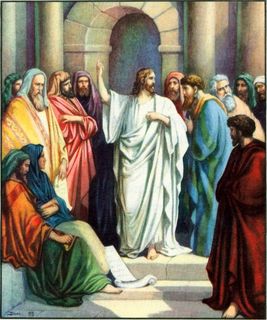 |
Jesus teaching
the Pharisees
The Gospel of Luke 16:19-31
19 There was a certain rich man, which was clothed in purple and fine linen, and fared sumptuously every day:
20 And there was a certain beggar named Lazarus, which was laid at his gate, full of sores,
21 And desiring to be fed with the crumbs which fell from the rich man’s table: moreover the dogs came and licked his sores.
22 And it came to pass, that the beggar died, and was carried by the angels into Abraham’s bosom: the rich man also died, and was buried;
23 And in hell he lift up his eyes, being in torments, and seeth Abraham afar off, and Lazarus in his bosom.
24 And he cried and said, Father Abraham, have mercy on me, and send Lazarus, that he may dip the tip of his finger in water, and cool my tongue; for I am tormented in this flame.
25 But Abraham said, Son, remember that thou in thy lifetime receivedst thy good things, and likewise Lazarus evil things: but now he is comforted, and thou art tormented.
26 And beside all this, between us and you there is a great gulf fixed: so that they which would pass from hence to you cannot; neither can they pass to us, that would come from thence.
27 Then he said, I pray thee therefore, father, that thou wouldest send him to my father’s house:
28 For I have five brethren; that he may testify unto them, lest they also come into this place of torment.
29 Abraham saith unto him, They have Moses and the prophets; let them hear them.
30 And he said, Nay, father Abraham: but if one went unto them from the dead, they will repent.
31 And he said unto him, If they hear not Moses and the prophets, neither will they be persuaded, though one rose from the dead.
What we highly esteem,
God calls abomination if it keeps us
from being Jesus’ disciples.
Luke 16 begins with Jesus talking about money and how some people misuse money, vs. 1-2. He is talking to Jews who thought they were better than Gentiles because they had wealth and earthly blessing. Jesus on Hell.
Then Jesus talks about using your money in a way that affects eternity, vs. 9-11.
Then Jesus says that what men highly esteem is abomination in the sight of God. An abomination is not a good thing.
Jesus is making a strong in your face point to the Pharisees, Luke 15:1-2 and to His disciples, Luke 16:1. Jesus on Hell.
Jesus on hell
Human beings highly value:
Unity
Sports
Wealth
Education
Popularity
Scholarship
Pop Culture
Fine Clothing
Social Status
Gourmet Foods
Expensive Possessions
God on the other hand, places high value on believing the Bible, character, integrity, honesty, faithfulness, obedience, compassion and service to others.
Have you noticed? The Bible never praises
human art, literature, inventions and wealth.
- The rich man in Luke 16 represents the Jews who were rich in worldly goods but did not believe in Jesus. Jesus on Hell.
- The beggar represents the Gentiles, whom the Jews regarded as unclean, dirty and far from God’s blessings.
- The Jews had Moses and the prophets but though they read them, they did not believe what they read in the written scriptures. Jesus on Hell.
- The Jews claimed to be Abraham’s children but they didn’t live faithfully like Abraham, who believed what God told him.
So Jesus tells a story in which a rich Jew who rejected Him dies and goes to hell and talks to father Abraham but can get no help from him. Jesus on Hell.
According to Jesus, the Jew’s problem was,
they didn’t believe the written scriptures.
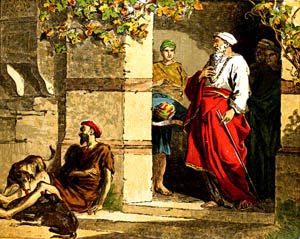 |
The rich man
and Lazarus
“a certain rich man” – Some people like to make this a parable and not true history, perhaps because Hell can then be said to be fiction and not a real place with real flames and real torment.
Notice that Jesus does not say this is a parable and Luke does not say this is a parable. However you interpret it, true history or parable, it is a story told by Jesus, about two men with polar opposite eternal destinations. Jesus on Hell.
- One man seemed to be a loser on earth, yet he goes to the good place when he dies.
- One man seemed to be a winner on earth, yet goes to hell when he dies.
Some people believe this story is nothing more than a lesson on treating people with compassion and does not teach us anything important about the afterlife. Jesus on Hell.
Given the excruciating details
Jesus gives in the story,
part of Jesus’ intention was
to teach us about the afterlife.
“clothed in purple and fine linen” – The rich man had all the trappings of great wealth. It’s not a sin to be wealthy. It is a sin to trust in your riches instead of trusting God. It is a sin to hoard your riches instead of using them to get the gospel to the lost, instead of using them to help those in need, like Lazarus the poor beggar.
“fared sumptuously every day” – This man enjoyed his riches, just as Solomon said he should. He enjoyed his wealth every day. Do you enjoy every day, the blessings God has given you? Do you hoard your wealth instead of using it to help people like Lazarus the poor beggar? Jesus on Hell.
Solomon said: “Behold that which I have seen: it is good and comely for one to eat and to drink, and to enjoy the good of all his labour that he taketh under the sun all the days of his life, which God giveth him: for it is his portion.” Ecclesiastes 5:18.
It’s interesting to notice that Jesus says nothing negative about the rich man. We know he is rich because of the way he is described. He wears expensive clothing like Kings wear. We know he eats well because Jesus tells us he enjoyed fine food every day. So far, Jesus seems to be painting the portrait of a virtuous man because in the Jewish understanding, prosperity was a sign of God’s blessing.
Even when the rich man is in hell, Abraham doesn’t reproach him for being rich. Instead, Abraham reminds the rich man of the blessings he used to enjoy and which he apparently did not share with those in need in his own neighborhood. Jesus on Hell.
“Son, remember that thou didst receive thy good things in thy lifetime.” Luke 16:25.
Nothing grossly sinful is pointed out about the rich man except his selfishness, his lack of love for a poor beggar he could have helped had he cared enough to do so. Yet the rich man dies and goes to hell and the beggar dies and goes to paradise or Abraham’s bosom. Jesus on Hell.
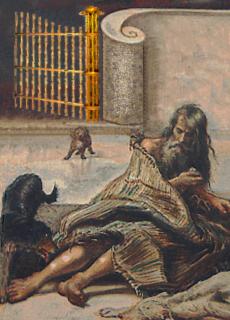 |
The beggar Lazarus
“there was a certain beggar named Lazarus”
Lazarus is a shortened form of the Jewish name Eliezer or Eleazer which means “God is my helper.” Exodus 18:4
The Hebrew speaking Jews to whom Jesus told this story recognized the beggar as “the good guy” in the story based on the meaning of his Hebrew name – God is my helper.
“full of sores” – Jesus draws a remarkable contrast between these two men. One is rich and well cared for, with plenty of food. The other is physically repulsive, poor and hungry and covered with sores. Ancient Jews regarded physical sickness as indicative that God had forsaken you, that God was not blessing you, Exodus 15:26.
“the dogs came and licked his sores” – Dogs were not loved in Jewish culture like we love dogs in American and western culture. Jesus is pointing out to us that Lazarus had no human being on earth, no friends to help him with food or medicine. He was alone and lonely in the world and only the stray dogs came and befriended him but no man cared for his soul or his body, including the rich man.
The story Jesus tells indicts the rich man as the bad guy, the man whom Jesus’ listeners would have regarded as the hero of the story is portrayed by Jesus as cold, uncaring, unloving, ungodly in spite of his outward blessing of wealth. Never think that your wealth means you have God’s favor. YOU could be the rich man in Jesus’ story who ends up in hell forever. Jesus on Hell.
Who are YOU in this story? Are YOU the poor beggar or are YOU the rich man? Which one do YOU want to be when YOU die?
Jesus intends us to see
the enormous contrast between
the earthly lives of these men.
“desiring to be fed with the crumbs which fell from the rich man’s table” – Jesus tells us that the rich man did not drive Lazarus away from his gate but helped to feed Lazarus. Yet the poor starving beggar received only crumbs while the rich man ate sumptuously every day.
Thoughtful readers question why the rich man did nothing to help the beggar, except to allow him the crumbs from his daily feasts. It was certainly within the power of the rich man to be a blessing to the poor beggar at his gate.
Jesus forever immortalized the rich man as a heartless villain. The same Jesus who told this story to the heartless Jews who wanted to kill Him, is watching your life, observing how you live. Will you end up like the rich man, leaving all of your money behind on earth as you die and go to hell?
What is Jesus teaching me?
Jesus teaches Hell 101
FREE pdf Bible study
May we apply this story to our own lives? We are the rich man. Is there someone in our life who is a beggar, whom we have the power to help if only we care enough to do so? Jesus on Hell.
Both men die. Solomon, in Ecclesiastes 2:14-16, reminds us that one event happens to all of us – we all die. Rich people die and poor beggars die every day. Jesus on Hell.
“And it came to pass, that the beggar died”
“And as it is appointed unto men once to die, but after this the judgement…” – Hebrews 9:27.
Each of us will die someday. And each of us will face what the beggar faced or what the rich man faced. Jesus on Hell.
What you face when you die and where you go when you die is up to you.
Do you remember when Jesus told us that the last would be first and the first would be last? That seems to be what happened in this story.
Remember, Jesus is talking
to Jews who rejected Him
as Messiah, who also rejected
the written scriptures
which spoke of Him.
Jesus reminds His Jewish audience that appearances can be deceiving. If you judge based on outward appearances, you’ll often be deceived. “Judge righteous judgment,” Jesus said in John 7:24.
“But the LORD said unto Samuel, Look not on his countenance, or on the height of his stature; because I have refused him: for the LORD seeth not as man seeth; for man looketh on the outward appearance, but the LORD looketh on the heart.”
All aboard the Wayback Machine!
If you could climb in a time machine and go way back two thousand years to visit the rich man and Lazarus before they died, what might you conclude by observing them?
- It would be natural to conclude that the rich man was saved and the beggar was lost. Jesus on Hell.
- It would be natural to conclude that Jews were saved and Gentiles were lost.
- Some people conclude that all gays are lost – this passage isn’t about gay and straight but remember not to assume the Bible says something it does not say.
God had obviously blessed the rich man so he must be the saved one.
And God obviously had not blessed the beggar Lazarus so he must be the lost one. Jesus on Hell.
Always remember, appearances
can be deceiving
“and was carried by the angels into Abraham’s bosom” – Abraham’s bosom speaks of paradise, the good place where good people go when they die.
Hades is the New Testament equivalent of the place known in the Old Testament as Sheol. It had two compartments. The good side, sometimes called paradise or Abraham’s bosom is where the saved go at death. Hell or the pit, the bad side, is where the lost go at death. Jesus on Hell.
 |
The Rich man died
“the rich man also died, and was buried.”
Two men, two lives, two appearances, two eternal destinies. We would naturally expect the rich man to go to the good place. But Jesus has a surprise for us and for the Jews. I wonder if any of the Jews to whom Jesus told this story about hell actually got saved? I wonder if anyone reading this sermon will take heed and actually get saved? Jesus on Hell.
News Flash! This Just In!
According to Jesus, hell is NOT
the same place as the grave!!!
“the rich man also died, and was buried; And in hell he lift up his eyes” – This is an astonishing revelation. According to Jesus, hell is not the same as the grave. Hell and the grave are not synonymous.
The rich man’s physical body was buried in a grave on earth but the rich man’s soul was tormented in hell. Regardless of what you’ve been taught, according to Jesus, Hell and the grave are NOT the same place. Jesus on Hell.
Big problem for the rich man! According to Jesus, the rich man is in hell and he is conscious and in torment. His soul is not asleep. He is not unconscious, waiting in the grave for the resurrection.
Instantaneously, when he dies, he goes to hell. His living soul is separated from his dead physical body but he is still sentient and conscious. And in hell, the rich man is tormented in flames. That is the story Jesus tells. It is true. It is reality. And wise readers will pay attention and get saved before it is eternally too late.
Only one life
‘Twill soon be past;
Only what’s done for Christ
Will last!
Jesus tells the truth about hell
- Many people believe that when you die, you’re dead like a dog.
- Some cults teach that when you die, you sleep in the grave till the resurrection.
- Some people embrace the false teaching that death of the physical body equals cessation of conscious existence.
- Jesus portrays hell as an awful place of fiery torment.
- Jesus portrays hell as a place from which no one can escape.
- Jesus portrays hell as a place where longings can never be satisfied.
- Jesus portrays the rich man in hell as more serious about evangelism than he ever was on earth.
According to Jesus, the beliefs many people have about hell are false. Jesus is unmistakably clear that the lost go immediately to hell when they die. They are conscious, not unconscious. They are tormented in flames and they want out but cannot get out. Jesus on Hell.
“being in torments… I am tormented in this flame” If this is only a parable and if there is no place called hell as the destination of the lost, Jesus is telling a very strange story. It’s time to get serious. Because Jesus told this story about hell, hell must be a real place of punishment and torment. Get saved today, right now! Don’t take a chance on going to hell for eternity!
The rich man in hell is conscious, thirsty, suffering and tormented in flames.
Not only that but the rich man can see into the good place and he must have been shocked to see the beggar Lazarus in Abraham’s bosom. Abraham’s bosom speaks of a place of honor, the place everyone would have expected the rich man to occupy but would never expect the beggar Lazarus to occupy.
That is the contrast Jesus draws, the more carefully to point out to the Jews their great spiritual need. Every wealthy Jew listening to Jesus imagined that when he died, he would have the place of honor in Abraham’s bosom.
None of them imagined that a poor wretched beggar would have that place of honor. The rich man is desperate to get out of hell but he cannot get up and go to the good place. He is trapped in hell for all eternity. Jesus on Hell.
According to Jesus, the rich man begs that Lazarus might come and dip the tip of his finger in water and cool the rich man’s tongue for he is tormented in flames. This is an awful story with a tragic ending.
The rich man whom everyone viewed as destined for heaven, died and went to hell.
Do you know for sure where YOU will go when you die?
The testimony of a man in hell, as Jesus tells the story, is that he is conscious, he is tormented in flames and he wants out.
But the rich man is told he cannot get out of hell, v. 26. Now the rich man in hell becomes evangelistic. He wants someone to go and tell his brothers about hell so they won’t go there when they die. The rich man in hell begs for a soul winning witness to go and try to get his brothers saved. He wants someone to tell his brothers about hell so they will get saved and not join him there.
But the rich man is told that IF his brothers won’t believe the written scriptures (Moses and the prophets), they won’t believe if the beggar Lazarus rises from the dead and goes to witness to them about Jesus – vs. 30-31.
- According to Jesus, everyone is not headed for heaven.
- According to Jesus, some of the people we think are going to heaven will end up in hell.
- According to Jesus, some of the people we think are going to hell will end up in heaven.
- Do YOU know where YOU are going when YOU die?
Lessons we learn
from Luke 16:19-31
- Appearances are deceiving. You can’t always tell who is saved and who is lost by outward appearances. The contrast between the rich man and Lazarus on earth was great but the contrast between Lazarus and the rich man in death was even greater.
- Having riches and fine clothing and good food does not necessarily mean you’re right with God or that you’re saved.
- Hell and God’s judgment are very real and we all need to get ready before we die. Once you’re dead, it’s too late.
- Hell is a real place of conscious loneliness and desperation and torment and flames.
- You can’t get saved in hell, according to Jesus in Luke 16. Once you’re in hell, it’s too late.
- People in hell are evangelistic and don’t want anyone else to go there.
- The rich man’s problem was that he and his brothers, for all their riches, didn’t believe the written scriptures – v. 29-31.
- God expects us to believe the written scriptures He gave in the Bible. If we refuse to believe the written scriptures, God is not obligated to do anything else for us. Do YOU believe the written scriptures? Do YOU believe Jesus? Do YOU believe the Bible?
The $64 million dollar question.
If you die today, do you know for sure
that you will go to heaven?
Jesus teaches Hell 101
FREE pdf Bible Study
What happens when you get saved?
From Jesus on Hell,
Return to GayChristian101 Home Page
This page updated January 27, 2017
 Subscribe It’s Free
Google Translate
into 90 languages

We are saved:
by grace alone through faith alone
Recent Articles

-
Gay Christian 101 – Affirming God’s glorious good news for all LGBs.
Jan 08, 24 12:57 AM
 Gay Lesbian Bisexual Christian 101 – Accurate biblical and historical info defending LGB Christians from the anti-gay crowd.
 -
Romans 1 describes ancient shrine prostitution, not gays and lesbians.
Dec 21, 23 04:37 PM
 Romans 1, in historical context, is about ancient Roman fertility goddess worshipers who engaged in shrine prostitution to worship Cybele, not gays and lesbians.
 -
The Centurion And Pais – When Jesus Blessed A Gay Couple.
Nov 14, 23 10:32 PM
 Centurion and Pais? If Jesus blessed a gay relationship, would this change your view of homosexuality?
Bible Study Resources
for eDisciples