Arsenokoites – What is
the historical meaning
of this rare Greek word?
In the Bible, arsenokoites / arsenokoitai
NEVER mean gay or lesbian.
 |
The Apostle Paul, by Rembrandt
In our previous study of arsenokoites, we listed the first 56 uses of the arsenokoit stem in extant Greek manuscripts to demonstrate that no ancient Greek writer used the word to mean lesbian or homosexual. As John MacArthur pointed out in a sermon on 1 Tim 2:12, citing The Pastoral Epistles: A Commentary on the Greek Text, George W. Knight III, 1999, William B. Eerdmans Publishing Company, Grand Rapids, MI.
“When you don’t have a lot of uses of a word in the Bible you go outside (the Bible) to find out how it was used.”
The arsenokoit stem is used only twice in the Bible, in 1 Corinthians 6:9 and 1 Timothy 1:10 but the apostle Paul does not define its meaning in either usage. What we do know with absolute certainty is that arseno-koitai did not mean lesbian or gay because it is never used with those meanings in any extant Greek manuscript available to us today.
There were a number of ancient Greek and Latin words Paul could have used in 1 Cor 6:9 and 1 Tim 1:10, if God intended to prohibit committed gay and lesbian partnerships yet he did not use any of them.
In our study of malakoi we demonstrated that malakoi usually referred to cult prostitution or shrine prostitution or temple prostitution or moral weakness or some kind of softness which implied effeminacy but malakoi was rarely, if ever, used to refer to homosexuality. Now we examine the origin of the arsenokoit stem, an extremely rare Greek word which is used only twice in the New Testament.
arsenokoites / arsenokoitai
occurs only 77 times
in extant Greek manuscripts
in the first 2100 years of Greek history. The arsenokoit stem is, therefore, an extremely rare word. In 1 Corinthians 6:9 and 1 Timothy 1:10, Paul is the first writer we have on record as using the word.
“Know ye not that the unrighteous
shall not inherit the kingdom of God?
Be not deceived: neither fornicators,
nor idolaters, nor adulterers, nor
effeminate (malakoi), nor abusers of
themselves with mankind” (arsenokoitēs).
1 Corinthians 6:9
“For whoremongers, for them that defile themselves with mankind (arsenokoitēs), for menstealers, for liars, for perjured persons, and if there be any other thing that is contrary to sound doctrine;“
1 Timothy 1:10
There are two reasonable possibilities for the origin of the Greek word, arsenokoitēs.
1. Hellenistic (Greek speaking) Jews coined the word from the Septuagint,
a Greek translation of the Hebrew Old Testament, based on use of the two Greek roots of the word in Leviticus 18:22 & 20:13.
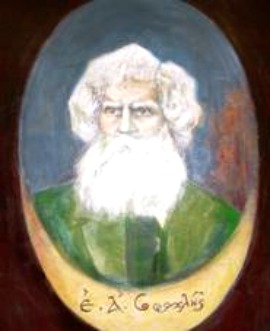 |
E.A. Sophocles
1807-1883
That is the view of Evangelinus Apostolides Sophocles, a native Greek speaker and from 1860 to 1883, distinguished Harvard professor of Modern Greek Language and Philology. Professor Sophocles wrote the Greek Lexicon of the Roman and Byzantine Periods from 146 BC to AD 1100, New York: 1887, p. 253 1206 pages, (a textbook still in use today).
This is also the view of Robin Scroggs, The New Testament and Homosexuality, Philadelphia: Fortress, 1983, pp. 86, 107-8, who believes that Paul’s use of the term was influenced by his familiarity with rabbinic terminology.
Leviticus 18:22 – meta arsenos ou koimethese koiten gunaikos
Leviticus 20:13 – hos an koimethe meta arsenos koiten gunaikos
Arseno is the Greek word for man and koite is the Greek word for bed, used euphemistically to mean having sex. We say ‘he slept with her’ when we mean, had sex with her. In the same way, koite-bed was a euphemism for having sex.
 |
Philo, Jewish philosopher,
20 BC – AD 40
If the prohibitions of the Levitical Holiness Code informed its meaning, arsenos koiten condemns shrine prostitution, based on the context of Leviticus 18 & 20.
Philo lived at the same time Jesus lived. During the life of Christ, Philo understood Moses, in Leviticus 18:22 and 20:13, to be condemning shrine prostitution. Philo’s understanding that the arseno-koit stem refers to shrine prostitution is 2000 years old. It is not a modern argument from gays and lesbians. Instead, it is the common first century Jewish viewpoint. Gays did not invent this viewpoint and because it did not originate with modern gays, it is not historical revisionism by gays seeking an alibi for our sin.
If the arsenokoit stem from Leviticus 20:13, arsenos koiten, gave us the Greek word Paul used in 1 Cor 6:9 (most anti-gay Christians believe Paul borrowed the word from the Septuagint translation of Lev 18:22 and 20:13), then understanding arsenokoites or arsenokoitai as a reference to shrine prostitution was the common first century view when Paul used the word in 1 Cor 6:9 and 1 Tim 1:10.
Philo on arsenokoites
and shrine prostitution
“(40) And I imagine that the cause of this is that among many nations there are actually rewards given for intemperance and effeminacy. At all events one may see men-women [androgynes] continually strutting through the market place at midday, and leading the processions in festivals;
and, impious men as they are, having received by lot the charge of the temple, and beginning the sacred and initiating rites, and concerned even in the holy mysteries of Ceres
[Ceres is another name for Cybele, the fertility goddess first century Romans referred to as the Mater Deum or Mother of the gods]. Remember, Philo lived from 20 BC to AD 40. He probably wrote this around AD 35.
(41) And some of these persons have even carried their admiration of these delicate pleasures of youth so far that they have desired wholly to change their condition for that of women, and have castrated themselves and have clothed themselves in purple robes…
[Philo here describes the castrated Galli priests who served Cybele or other fertility goddesses worshiped in Rome].
(42) But if there was a general indignation against those who venture to do such things, as was felt by our lawgiver…”
Moses was the Jewish Lawgiver. Philo refers to Moses’ writings in Lev 18:22; 20:13 and Deu 23:17 and links those verses to the shrine prostitution he has just described. Philo, The Special Laws,
Understand This:
Philo believed that Moses’ use of
arsenos koiten in Leviticus 20:13
referred to temple prostitution.
The modern attempt to morph Leviticus 18:22 and 20:13 into a prohibition of all homosexual activity is not the historical understanding of those verses, is not what God and Moses intended and is not the ancient Jewish understanding of these verses.
The Jewish viewpoint articulated by Philo is 2000 years old. It was not invented by gay people as an excuse for our sin. Understanding arsenokoites to refer to cult prostitution or shrine prostitution or temple prostitution is the commonly understood meaning of arsenokoites in the first century AD.
Arsenokoites also condemns pederasty and incest, given the interpretation of Leviticus 18:22 and 20:13 in Sanhedrin 54a and 54b and Philo.
Shrine prostitution, pederasty and incest are not analogs of a committed faithful monogamous partnership between two men or two women.
2. Paul coined the word, arsenokoites,
borrowing from the Greek words of Leviticus 18:22 and 20:13. This is the view of some anti-gay commentators including James B. De Young, Th.D., professor of New Testament Literature and Language at Western Seminary, Portland, OR, in his article, ‘The Source and NT Meaning of Arsenokoitai with Implications for Christian Ethics and Ministry,’ The Masters Seminary Journal, 3 (1992).
Professor De Young takes the view that arsenokoitai refers to and condemns homosexuality. Regardless Professor De Young’s anti-gay conclusion, Paul’s use of the arsenokoit stem must have indicated a sin which confronted Paul’s readers, with which they were so familiar that it was not necessary for him to define the word. The best historical possibility for its meaning is cult, shrine or temple prostitution.
Some modern scholars insist that shrine prostitution did not occur in ancient Corinth. Whatever the outcome of that argument, Philo, who was intimately familiar with cultic religion in the first century, identifies Cybele or Ceres worship with the shrine prostitution Moses referenced in Leviticus 18:22 and 20:13.
Because Paul did not define the word arsenokoites when he used it, the meaning must have been clear to Paul’s first century readers.
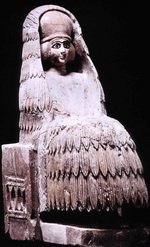 |
Ashtoreth, a fertility goddess idol
Philo leaves us in no doubt about the meaning of arsenokoites. For first century Jews, it was a given that the arsenokoit stem referred to temple prostitution. The first century cultural and historical understanding is that arsenokoites refers to shrine prostitution, in which male worshipers engaged in anal sex with male priests and female priestesses of the fertility goddess.
Conservative scholars agree
Other conservative Christian scholars who are not pro-gay agree with Philo and gay Christians on this point. For example, Australian scholar Dr. Leon Morris (his Ph.D. is from University of Cambridge), in the Tyndale New Testament Commentary on 1 Corinthians writes: “The inclusion of idolaters may point us to the immorality of much heathen worship of the day.”
Charles Eerdman, in his helpful commentary on 1 Corinthians says: “The practice of impurity formed a feature of idolatrous worship.”
Even anti-gay Calvinist Phil Johnson, a co-worker at John MacArthur’s conservative evangelical Grace To You ministry, and certainly not given to defending gay Christians, admits this truth about 1 Cor 6:9, when he writes:
“At the heart of all the problems in the church at Corinth… a city filled with both temples and brothels—where fornication was literally deemed a religious rite…
The vast majority of the Jewish community in Corinth had rejected the gospel (Acts 18:6). So the church was made up of mostly Gentiles who, of course, came from a culture that was not inclined to see sexual sin as unspiritual. Just the opposite. Most of the “religion” in Corinth involved temple prostitution and debauched sexual behavior.” -Phil Johnson on Pyromaniacs Blog, January 31, 2011.
This cultic sexual activity in worship of the fertility goddess is what God and Paul intended to forbid and what Philo decried. Aphrodite, Ashtoreth, Astarte, Ceres, Cybele, Fortuna, Gaia, Isis, Minerva and Rhea were all fertility goddesses worshiped by our first century ancestors. The names are often interchangable (different names used by different cultures) to refer to the same goddess.
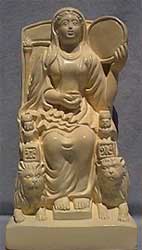 |
Cybele, a fertility goddess idol
First century Jewish thinking linked Lev 18:22 and 20:13 to incest, pederasty and shrine prostitution, based on Sanhedrin 54b, which references 1 Kings 14:24. Philo also linked Lev 18:22 & 20:13 to cult or shrine or temple prostitution.
1 Kings 14:24
“There were even male shrine prostitutes in the land; the people engaged in all the detestable practices of the nations the LORD had driven out before the Israelites.” NIV
“and there were also male cult prostitutes in the land. They did according to all the abominations of the nations that the LORD drove out before the people of Israel.” ESV
“And there were also sodomites in the land: and they did according to all the abominations of the nations which the LORD cast out before the children of Israel.” KJV
Philo was a contemporary of Jesus and Paul. These historical facts and this first century Jewish view of the meaning of Lev 18:22 and 20:13 certainly influenced Paul’s use of arsenokoites, whether or not he coined the word.
There is no biblical, cultural, historical, religious or scriptural reason to assume Paul intended to convey a twenty first century, conservative Christian viewpoint (universal proscription of all homosexual practice), to his first century readers.
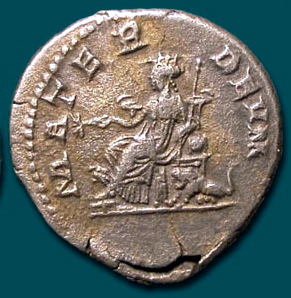 |
Cybele the fertility goddess,
referred to on this ancient Roman coin as Mater Deum, “mother of the gods,” was so influential throughout the Roman Empire that coins with her likeness were used everywhere as legal tender.
A compound word does not
always equal the sum of its parts
Arsenokoites is a compound Greek word, formed by joining arseno – man and koite – bed. A compound word does not always equal the sum of its parts.
Dr. James Barr on compound words like arsenokoites or arsenokoitai
 |
Dr. James Barr, 1924-2006,
lauded by the Times Online obituary as “probably the most significant Hebrew and Old Testament scholar in Britain in the twentieth century.”
James Barr, influential Bible scholar and linguist, was born on March 20, 1924 and died on October 14, 2006, aged 82, in Claremont, California.
Born in Glasgow, Scotland, Barr served as a pilot in the British Royal Navy, 1942-45, during World War II. He earned his doctorate from Oxford University where he later served as Professor.
Dr. Barr taught at Presbyterian College, Montreal (Professor of New Testament), Edinburgh University (Professor of Old Testament Literature and Theology), Princeton Theological Seminary, Manchester University (Chair, Department of Semitic Languages), Oxford University (Oriel Professor of the Interpretation of Holy Scripture and later as the Regius Professor of Hebrew), the University of Chicago and Vanderbilt University (DIstinguished Professor of Hebrew Bible), until his retirement in 1998.
The Semantics of Biblical Language, 1961, was probably Dr. Barr’s most important book in that it successfully demolished a long and erroneous tradition of attributing to Biblical words and their etymologies, a linguistic significance and meaning the Biblical words themselves did not possess in actual historical usage.
The Times Online notes concerning Dr. Barr’s seminal work, The Semantics of Biblical Language:
“Theologians felt bereft having been deprived of that age-old prop of their profession, i.e., the exegesis of concepts by means of semantic images and speculations. Barr made some enemies with this book, but once its importance had been recognised his scholarly reputation was firmly established.”
Here is what Dr. Barr said about etymology.
“The main point is that the etymology of a word is not a statement about its meaning but about its history…
…it is quite wrong to suppose that the etymology of a word is necessarily a guide either to its ‘proper’ meaning in a later period or to its actual meaning in that period.”
James Barr, The Semantics of Biblical Language, Oxford University Press, New York, 1961, p. 109.
Thank you Dr. Barr. We cannot take the composite parts of arsenokoites and based on the meaning of those parts, insist that arsenokoites means homosexual when our ancient Greek ancestors did not use arsenokoitai or arsenokoites with that meaning.
Etymology does not
determine meaning
“The etymological fallacy is to assume that the origin of a word is its true meaning. No, the true meaning of a word is its current usage.” – Dr. Robert J. Cara, Chief Academic Officer and Professor of New Testament, Reformed Theological Seminary
“Usage determines the meaning of words” – James L. Boyer, “Semantics in Biblical Interpretation,” Grace Journal, Vol. 3, No. 2, Spring 1962.
“The meaning of a word depends on its usage, not on its derivation” – “Biblical Exegesis and Hermeneutics,” Encyclopedia Britannica, Macropaedia (1974), Vol. 7, p. 61.
“Usage determines the meaning of words” – Rollin T. Chafer, The Science of Biblical Hermeneutics (Dallas, TX: Bibliotheca Sacra, n.d.), p. 28.
“As already stated, often the etymology of a word does not help determine its meaning. Therefore we need to determine its current established usage by the writer. This practice is called uses loquendi (literally, the use by the one speaking). In other words what was the customary meaning of the word when the writer used it? How he used the word in context often helps determine its meaning.” – Roy B. Zuck, Donald Campbell, Basic Bible Interpretation: A Practical Guide to Discovering Biblical Truth, p. 103.
Remember, it is intellectually dishonest to give words like arsenokoites a linguistic significance and meaning the biblical word itself did not possess in actual historical usage.
There is not a shred of objective evidence that Paul used arsenokoites to mean homosexual. Notice what happens when we attempt to define compound words based on the meaning of their individual parts.
Examples of compound words which
have a meaning different than
the meaning of their parts
- Mandate – Oh my, that sounds SO exciting! Obviously man-date can only mean, a man on a date with a man, because when we break down the word mandate the way anti-gay Christians break down arseno-koitai to mean: have sex with a man; man+date must mean a date with a man. I’m using absurdity to make a point. That is a silly way to discover word meanings. A mandate is not and never has been a date with a man. A mandate is a command, authorization or permission to perform a duty or a task. It has nothing to do with dating a man. The meaning of mandate is not the sum of its parts.
- Butterfly – A dairy product with the ability to defy gravity? A fly who hangs around the dairy? The meaning of butterfly is not the sum of its parts.
- Flywheel – A round piece of metal that flies through the air? A miniature wheel invented by a fly? The meaning of flywheel is not the sum of its parts.
- Ladybug – A strange creature, part etiquette-conscious woman and part insect? A lady who loves bugs? A lady who hates bugs? A bug who loves ladies? The meaning of ladybug in not the sum of its parts.
- Mankind – A man noted for his generous, always sympathetic, warm-hearted spirit? Tonto, describing the Lone Ranger? Mankind does not mean a man who is kind. The meaning of mankind is not the sum of its parts.
- Chairman – A man who makes chairs? A chair for men only? A man who sells chairs? A man who sits in chairs? The meaning of chairman is not the sum of its parts.
- Ladykiller – A woman of impeccable manners who murders others? A man who kills ladies? The meaning of ladykiller is not the sum of its parts.
What is a Ladykiller?
The word ladykiller might mean precisely that when speaking of Aileen Wuornos, the female serial killer who literally killed men or Ted Bundy, the male serial killer who literally killed ladies. But defining ladykiller by the meaning of its individual parts does not always provide an accurate definition.
When used to describe a movie star like Brad Pitt, ladykiller refers to a man who loves ladies and who is loved by ladies but who does not literally kill ladies. This most common usage of ladykiller has nothing to do with the literal meaning of its parts.
Arsenokoites is a compound word
Just so, interpreting the compound word arseno-koites or arsenokoitai to mean homosexual, because arseno by itself means man and koite by itself, is a Greek euphemism for sex, is linguistically inaccurate. Ancient Greek writers, including the apostle Paul, never used arsenokoites that way.
The modern tendency which assumes arsenokoites must mean homosexual, ignores historical usage of the word. The modern assumption is based on the wishful thinking of anti-gay Christians, not the way arsenokoites was actually used in antiquity.
The fact that arsenokoites was never used in ancient times, to refer to men in committed homosexual partnership, provides a powerful clue that arseno-koites does not mean homosexual.
An ancient example where
the arsenokoit stem
did not mean homosexual
The following quotation is attributed to John the Faster, Patriarch of Constantinople, around AD 575. Here, the word arsenokoitia, refers to a man having sex with his wife.
“One must also ask about the perplexing, beguiling, and shadowy sin of incest, of which there are not just one or two varieties but a great many very different ones. One type is committed with two sisters of the same father or mother (or both). [Jacob with Leah and Rachel]
Another involves a cousin; another the daughter of a cousin; another the wife of one’s son; another the wife of one’s brother. It is one thing with a mother-in-law or the sister of a mother-in-law, another with a stepmother or a father’s concubine.
Some even do it with their own mothers, and others with foster sisters or goddaughters. In fact, many men even commit the sin of arsenokoitia with their wives.”
John the Faster, Penitential, about AD 575. This quotation is ascribed to John the Faster although the provenance is disputed.
None of the citations given
in Greek lexicons to support
arsenokoites having our
modern meaning of homosexual
uses the word with that meaning.
Arsenokoites and arsenokoitai were never an exclusive reference to homosexuals nor were they used to refer to lesbians. In 56 usages during the six hundred years after Paul first used the word, arseno-koites or arseno-koitai never refers to men in committed faithful gay partnership or gay marriage. And it probably goes without saying that the word was never used to describe two women in committed faithful partnership or gay marriage.
Deconstructing a word to obtain the meaning of its parts, and then assuming that the meaning of the parts equals the meaning of the whole, leads to linguistic error.
Defining arsenokoites based on the meaning of arseno and koite tells us nothing about the meaning as Paul and his readers understood it.
The common error, found even in Greek lexicons, that arsenokoites means “homosexual men who have sex with men” may explain the etymology of arseno and koites but does not explain their meaning when they form one word.
Helpful Links to more information

What is justification by faith?
What is the
historical meaning of malakoi?
Still think the Greek word malakoi
always means homosexual?
What ancient Greek or Latin words
could Paul have used if
he intended to condemn homosexuality?
Gay Christian 101:
Spiritual Self-Defense For Gay Christians
From arsenokoites, return to
Gay Christian 101 Home Page.
Google Translate
into 90 languages

We are saved:
by grace alone through faith alone
Recent Articles


-
Gay Christian 101 – Affirming God’s glorious good news for all LGBs.
Jan 08, 24 12:57 AM
 Gay Lesbian Bisexual Christian 101 – Accurate biblical and historical info defending LGB Christians from the anti-gay crowd.
 -
Romans 1 describes ancient shrine prostitution, not gays and lesbians.
Dec 21, 23 04:37 PM
 Romans 1, in historical context, is about ancient Roman fertility goddess worshipers who engaged in shrine prostitution to worship Cybele, not gays and lesbians.
 -
The Centurion And Pais – When Jesus Blessed A Gay Couple.
Nov 14, 23 10:32 PM
 Centurion and Pais? If Jesus blessed a gay relationship, would this change your view of homosexuality?
Bible Study Resources
for eDisciples